
A kind gift you give while you’re still here.
If the phrase Swedish Death Cleaning makes you flinch a little, you are not alone. It sounds morbid. It isn’t.
It also isn’t the only name for what we are about to talk about. I have started calling it Next Life Chapter Preparations — same idea, much less heavy. Both names describe the same kind act, so I will use them interchangeably in this post. Take the one that feels right.
At its core, this is a simple, thoughtful idea, popularized by the Swedish author Margareta Magnusson:
Do some of the sorting now, so the people you love don’t have to do all of it later — while they are grieving.
That is the difficult part. The lighter part is what makes life better today: fewer piles, fewer mystery boxes, fewer things shouting for your attention. More breathing room. More clarity. More choice.
This is not about becoming a radical minimalist. It is about being realistic. Your home should support the life you are living now — and it should be manageable for the people who come after you. Swedish Death Cleaning (or Next Life Chapter Preparations, if you prefer) is one of the most respectful ways I know to get there.
What This Really Is
The Swedish word is döstädning. The German equivalent — for those of us who came from that direction — is somewhere between aufräumen and entrümpeln. Different languages, same instinct.
The approach asks three honest questions:
- What is worth keeping because it is meaningful, useful, or tells a story?
- What is staying only because it is easier not to decide?
- What would my family actually want — and what would become a burden?
It is less purge everything and rather more curate a life. Think of it as doing future you, and future them, a quiet favor.
The Most Honest Question in the Whole Method
Here is the question that cuts through almost every difficult decision:
Would anyone I know be happier if I keep this?
Not Could this be worth something? Not What did I pay for it? Not What if I need it someday?
Just: would keeping it create happiness — or create work?
A second question helps when the item is sentimental:
Does this tell my story in a way somebody else would understand?
Because the truth is rather simple. An object without context can become weight very, very fast — even if it mattered deeply to you.
Is This For You?
You do not have to be a certain age. You do not have to be sick. You do not have to be in crisis.
But the approach tends to resonate if you recognize yourself in several of these:
- I do not want my family to deal with a house full of decisions someday.
- I have closets, bins, or a basement that feels like a time capsule.
- I keep just in case items I rarely (or never) use.
- I have sentimental items I care about — but I am not sure anybody else will.
- I have thought, “I should really get rid of this,” and then quietly avoided it.
- The idea of leaving behind mystery boxes makes me uneasy.
- I am going through (or expecting) a life transition: downsizing, retirement, kids leaving home, divorce, aging parents.
- I want more calm and control now — not just less later.
And the not yet signs, equally honest:
- I am in active grief or crisis and cannot make decisions right now.
- I feel pressured by somebody else to do this, and I resent it.
- I am hoping my family will want everything I own.
- I am not willing to let go of anything yet — even duplicates, broken items, or obvious weight.
If you checked several yes boxes, this is not a warning sign. It is an opportunity.
The Three Principles
Consideration for others. You are not trying to leave nothing. You are trying to leave a manageable, meaningful set of belongings — not a mountain.
A slow process, not a weekend purge. This is gentle work, done in layers. Easy wins first. Sentimental categories much later.
Focus on legacy, not volume. Legacy is not measured in bins. It is measured in meaning. Next Life Chapter Preparations help you keep the best and release the rest — with intention.
How to Start (Without Turning Your Life Upside Down)
If you start with the most emotional category first, you will stall. That is human.
Build momentum on the easy stuff:
- Clothes that do not fit or never get worn
- Kitchen gadgets you do not use
- Duplicates (three spatulas, five phone chargers, two slow cookers)
- Old towels and worn-out linens
- Broken items you have meant to fix for years
Then move to the hidden categories:
- Under-bed storage
- The linen closet
- Garage shelves
- The basement good stuff pile
- A storage unit, if you have one
Save the sentimental for later. Once you have built decision muscles, sentimental gets quite a bit easier — because you have created space and clarity first.
A Simple Tool: The Red Dot System
If you want a visual way to move faster, try a sticker system.
- Red = let go
- Green = keep
- Yellow = not sure (decide later)
This is powerful because it reduces decision fatigue. You are not forcing yourself into yes-or-no on everything. Yellow is not failure. Yellow is strategy.
What About Private Items?
This is the part most people do not say out loud, but everybody thinks about.
Next Life Chapter Preparations include handling items you do not want others sorting through later: private letters, diaries, sensitive photos, personal files, old devices with data.
The simplest version of this is two boxes. The same Two Boxes you will find on the Smart Reduction™ and Legacy Creation service pages — because they belong to both:
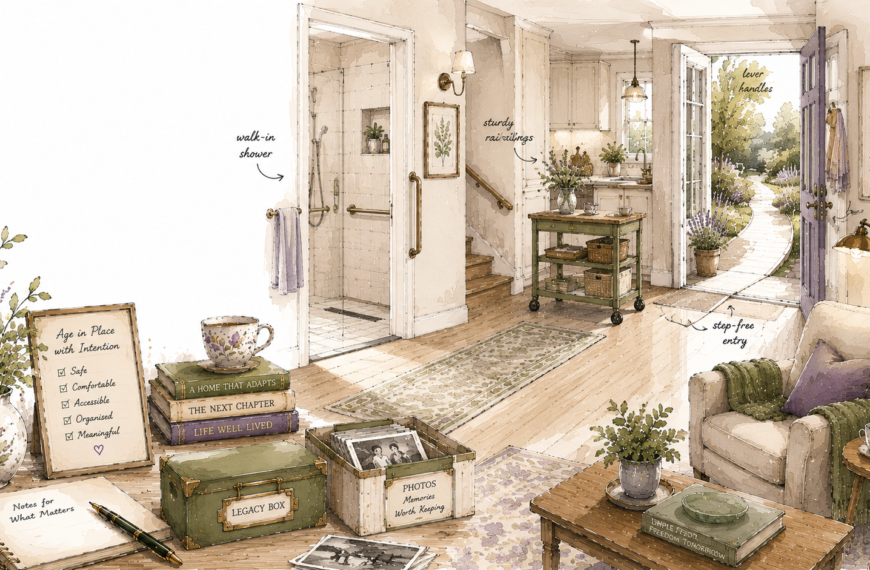
- The Legacy Box. Items and information others will genuinely need. Passwords. Will and estate documents. Account information. Keys. Funeral wishes. Advisor contacts.
- The Private Box. Items that mattered to you in life but are not meant to be passed on. Personal letters, journals, private photographs, drafts, sensitive devices. Clearly labeled with instructions to release later.
Two boxes. Big peace of mind. An act of kindness, on both ends.
The “Perfect Age” Question
There is no perfect age. Magnusson suggests that many people find their stride with this in their 60s and 70s, partly because energy and health change — and it is a relief to live lighter while you still can.
My honest take, as somebody in his early sixties: if you can still make decisions clearly, you are at the perfect age to start.
And if you are in your forties or fifties? Even better. You will enjoy the benefits longer, eye-to-eye with a much, much lighter home for decades to come.
The Real Win — Life Gets Better Now
The best part of Next Life Chapter Preparations is not what happens someday.
It is what happens next week, when you open a closet and feel space. When you know where things are. When your home reflects the life you are living, not the life you used to live.
This is the practical art of keeping the right things — and letting the rest move on with care.
Where This Meets Legacy Creation
Smart Reduction™ clears space. Legacy Creation captures the meaning of what stays. Swedish Death Cleaning sits exactly at the bridge between them — which is why it appears in both service conversations on the Secret SOZZ site.
The work of Next Life Chapter Preparations is, in plain terms, the whole trifecta in slow motion: clear the rooms, organize the photos and accounts, capture the stories that the keepers carry.
If You’d Like Help
If this feels meaningful but also overwhelming, you do not have to do it alone. A good guide helps you stay calm, move faster, make decisions with less second-guessing, and keep the meaningful items — and the stories that go with them — intact.
Schedule a free Smart Reduction™ discovery call.
A Secret SOZZ post — simple recipes for a better life.
#Secret-SOZZ #Smart-Reduction #Legacy-Creation #Swedish-Death-Cleaning #Next-Life-Chapter-Preparations