
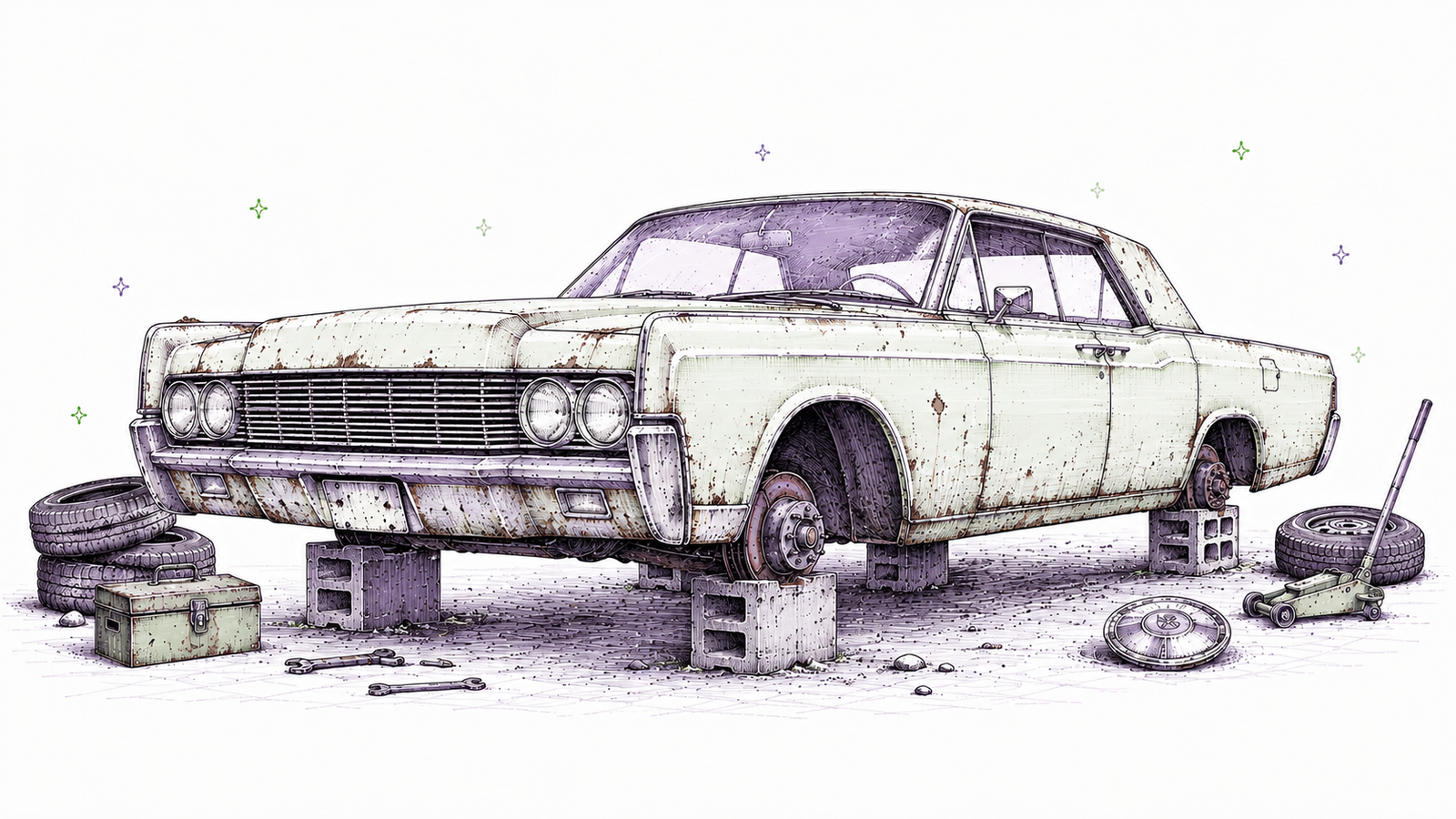
When a dream on wheels becomes a weight on your life. And how to tell the difference.
I admire cars. I visit them in museums. I do not own one under a tarp.
That confession matters here. Because what follows is not a wrench-turner’s lecture on project cars. It is the perspective of somebody who loves the things — who could spend a Saturday at the Petersen, the Forney, or a quiet afternoon in Stuttgart looking at the Porsche 356 again — and who chose, deliberately, never to park one in his own garage.
America loves cars. We also love the idea of a car.
That is how so many “project cars” are born. A classic truck in the back of the garage. A vintage coupe under a tarp. A half-restored something that has been “almost ready” since the last decade.
And look — I get it. A project car can represent freedom, craftsmanship, and identity. It can connect you to a community that will welcome you for life. It can be a beautiful keeper, especially the cars that actually get driven.
But it can also become one of the quietest, biggest, and most expensive ways to weigh down a life — because what it takes up is much, much more than space.
So let’s talk about it the Smart Reduction™ way. No shame. No judgment. Just clarity.
The Question Isn’t “Do I Like This Car?”
The real question is rather simpler:
Is this car still an active project — or has it become a parked promise?
A parked promise is an unopened box with a bigger footprint. It holds potential. Potential only pays off when it turns into action.
This is exactly where my Clutternomics™ lens helps.
The Five Clutternomics™ Lenses for a Project Car
1. Space Cost — what is this car displacing?
A non-running car takes up prime real estate. A garage bay that could hold the daily driver. A workshop you could actually use. Room for bikes, gear, tools, or simply the breathing room a clear space gives you.
If the car lives outside, the cost continues — curb appeal, parking, occasional neighbor tension, and weather damage as well.
Clutternomics™ question: What would this space enable if it were free?
2. Use & Access — are you actually working on it?
Let’s be honest. The most common restoration schedule looks like this:
Next spring.
When things calm down.
Someday.
If you have not touched the project in a year, the issue is not motivation. The issue is reality. And reality is rather stubborn about getting noticed sooner or later.
Clutternomics™ question: When did I last move this project forward in a real way?
3. Value & Replacement — does the math work?
Some project cars are worth real money. Most are not — at least not in their current condition.
Ask honestly:
- What would this car sell for today, as-is?
- What will it cost to make it roadworthy? (Not perfect. Just safe and legal.)
- What is the realistic resale value once done?
- Are you factoring in your own time, eye-to-eye with the calendar?
This is where many people get stuck. We tend to overvalue what we already own, especially when it carries a story.
Clutternomics™ question: Am I holding value, or holding onto a story?
Stories matter. Stories do not need a garage bay.
4. Opportunity — what could this become?
Even if the car technically pencils out, ask the deeper question.
Does restoring this car move you toward the life you want now? Would you rather be traveling, with family, building fitness, taking on a new hobby, or simply living with quite a bit less weight?
No moral ranking. Just an honest question. Time is the most precious commodity any of us has.
Clutternomics™ question: If I freed up this time and space, what would I do more of?
5. Legacy — does this carry meaning worth keeping, or worth passing on with intention?
This is the lens most project-car conversations miss. Project cars are often inheritance stories. Your grandfather’s ’67 Mustang. Your father’s first restoration. The car you have been quietly saving for your son — who lives in a different city and has indicated, gently, that he does not really want it.
Ask honestly:
- Whose meaning is in this car?
- Does the next generation actually want it, or are you assuming?
- Could the meaning be honored another way — photographs, a written history, a piece of the car preserved deliberately?
A car can be a beautiful inheritance. It can also be a heavy one. Knowing the difference is the work of Legacy Creation.
Clutternomics™ question: Is this car for me, for them, or for the story we share?
A Practical Reality Check
Three small but honest questions about whether you are set up to succeed:
- Parts. Still available at reasonable cost?
- Skills or support. Do you have what you need, or know who to call?
- Workspace. Tools, lighting, a place to put the engine down for the night?
A car can be a hobby. It can also become a source of low-grade guilt for years. The difference is usually visible at this short checklist.
When a Project Car Does Make Sense
I am not anti-classic-car. Not at all.
A project car can be a fantastic keeper if the conditions are right. Signs of a healthy project:
- It is close to running, or already runs.
- You work on it consistently — even small steps count.
- You have the space, the tools, or the support.
- Parts are available and rather affordable.
- You are part of a classic car community, or want to be.
- It brings you genuine joy, not lingering guilt.
- You can describe the next three steps without thinking too hard.
If that is you — go for it. Join the community. Take it to meets. Make it a living hobby, not a dormant obligation.
A classic car is at its best when it is driven, shared, and appreciated.
When It’s Time to Let It Go
A project car is no longer a project when:
- It has not moved forward in years.
- You do not have the time — and will not soon.
- You do not have the skills, the desire, or the support.
- Parts are hard to source, or pricey beyond reason.
- You feel stuck, not excited.
- It has become a stressor in your home, your marriage, or your conscience.
If that is the case, letting go is not failure. It is Smart Reduction™.
You can still love classic cars without storing one. How about visiting them in museums? Going to car shows on weekends? Joining a local car club without owning the car? Helping a friend restore theirs? Volunteering at an automotive heritage organization?
A love of cars does not require ownership. Sometimes it is easier without.
A Simple Decision Framework — Keep, Sell, or Release
Pick one. No fourth option. Clarity creates momentum.
Option A — Keep, and make it real. Set a start date. Define three next steps you can describe out loud. Budget the time and the money. Build a realistic timeline. Join a community so the project becomes social, not solitary.
Option B — Commit to a sale. Clean it up enough to photograph well. Gather paperwork, keys, parts, and history. List it honestly, as-is. Price it realistically — overpriced is the same as not selling. Choose a deadline.
Option C — Release, and reclaim your space. Donate (some organizations accept vehicles, parts, or scrap). Sell to a restorer who actually wants the project. Recycle responsibly if the car is genuinely beyond saving. Reclaim the garage bay, and use it intentionally.
The Big Takeaway
A project car is either a living hobby, or a parked promise.
Your home should not be a storage facility for promises. It should support the life you are living now.
If you love cars, love them well. Drive one. Visit them in museums. Join the club. Hand the meaning down on purpose. Just do not let a tarp in the garage carry the weight of a dream you have stopped showing up for.
Smart Reduction™ is about choosing keepers first. Sometimes the keeper is a beautifully running classic. Sometimes the keeper is the space you get back. Both can be the right answer. Only one of them keeps moving you forward.
If You’d Like Help
If you would like a clear-eyed conversation about the car in the garage — or the larger question of what to keep as you move into your next chapter — Smart Reduction™ is exactly that work. As a coach, side by side, or by taking on more of the heavy lifting. Plain English, simple wording, no judgment.
A Secret SOZZ post — simple recipes for a better life.
#Secret-SOZZ #Smart-Reduction™ #Clutternomics™ #Project-Car