
Smart Reduction™ for the shelves, the stacks, and the “I’ll read it someday” pile.
I have about four hundred books in my home. Some are read. Some are not. A few are read three times. A handful are in German. One or two are signed. One is Fifty Years of Motorized Flying — a book I picked up in bed while sick and have not quite put down since.
I am a reader. I keep books. I also let books go, sometimes with regret, occasionally with quiet relief.
What follows is the same Smart Reduction™ approach I use with clients. No shame. No KonMari. No throw-everything-in-a-bag panic. Just a thoughtful look at which books earn their place on the shelf, and which ones are quietly waiting to be passed on.
The Quiet Reality
Books are one of the most common “good weight” categories. They look intelligent. They feel sentimental. They represent who we are — or who we wanted to be when we bought them.
And then they multiply.
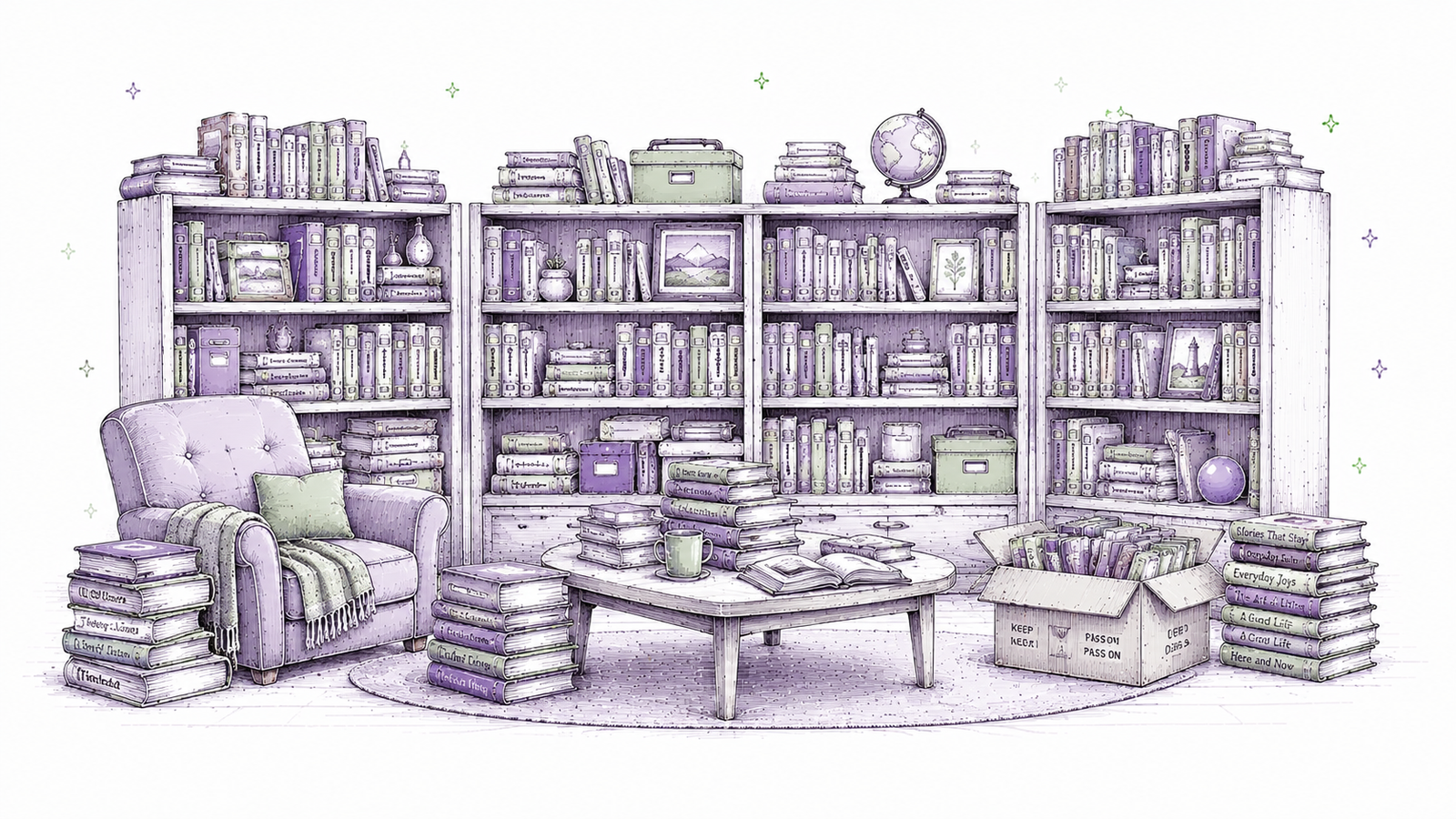
In most homes I walk through, books show up in three places. On shelves (the visible library). In stacks (nightstands, floors, corners). In boxes (basement, garage, storage unit — also known as the time capsule).
This post is not about getting rid of books. It is about curating a collection you actually use and love — and letting the rest move on to people who will.
A Reality Check, Gently Delivered
Oliver Burkeman wrote a book called Four Thousand Weeks. That is, roughly, how many weeks a person gets, all in.
If you read ten books a year — already rather more than the American average — that’s about four hundred books across the rest of an average life.
If your “to read” pile is much, much bigger than that, the pile is no longer a reading list. It is a stress list wearing a cardigan.
A small mindset shift, freely offered: your unread books are not a personal failure. They are inventory. You are allowed to release them.
Step 1 — Pull Them Into One Place
If you want clarity fast, gather the books from every room. Include the stacks. Include the boxes from the basement. Include the temporary piles that have quietly become permanent. Put it all in one sorting zone — the living room floor works.
This step matters because it reveals the truth: your book collection isn’t what’s on the shelf. It is everything you own.
Step 2 — Sort Into Five “Keep” Categories
Most book collections can be sorted into five honest categories. The categories that matter are the ones a book is honestly for.
1. Read or Re-Read
Books you actually plan to read, or would happily read again.
Home: anywhere convenient — a bedroom shelf, a reading nook, the living room. Klaus rule: If a book has been “next” for five years, it is not next.
2. Display and Identity
Books that support the feel of your home, or represent a part of you. Art books. Travel books. Photo-heavy books. A few this is me titles.
Home: a curated shelf, the coffee table, a focused display zone. Klaus rule: A display shelf should breathe. A crammed shelf reads as something else entirely.
3. Reference and Future Projects
Cookbooks you actually use. Gardening books you consult in March. Business resources you revisit. Manuals for the camera you still own.
Home: near the point of use — the kitchen, the office, the workshop. Clutternomics™ prompt: If it is a reference book, can you name the last time you used it?
4. Sentimental and Keepsake
Signed books. Childhood favorites. The book with margin notes from your mother. The cookbook with your grandmother’s handwriting.
Home: a keepsake box or a dedicated memory shelf. Klaus rule: Sentimental books deserve respect. That means protection. Not damp basement boxes.
5. Investment or Collectible (rare — but real)
First editions. Signed copies. Niche collectible sets. Rare bindings.
Home: a safe location with stable temperature and humidity. Klaus rule: If you are not willing to store it like an investment, it is probably not one.
Step 3 — Everything Else Goes Into “Let Go” Buckets
Once the keepers are chosen, the rest needs a clear exit path. Three honest options:
Donate. Local thrift stores. Libraries (some accept, some do not — call first). Community centers. Shelters. The goal is simple: get the book into hands that will use it.
Give to a friend, with intention. Offer a small curated stack — I think you’d love these three — rather than a box on the porch. A targeted hand-off works much, much better than a generic dump.
Recycle, if the book is genuinely damaged. Mold, missing pages, water damage. The dignity is in not pretending the book is still usable.
(Selling is usually worth it only for collectibles, bundles in high-demand categories, or local same-day pickup lots. For most books, donation wins on speed, space, and sanity.)
A Quick Filter: Should I Keep This Book?
A short checklist, eye-to-eye with each title. If you hit multiple no answers, it is likely a release.
Keep it if:
- I will read or re-read it in the next twelve months.
- I use it as a reference and can name why.
- It supports the feel of my home and I would miss seeing it.
- It is truly sentimental, and I want to preserve it intentionally.
- It has real resale or collectible value, and I will store it properly.
Let it go if:
- I’m keeping it out of guilt (“I should read this”).
- I cannot remember why I bought it.
- It belongs to aspirational me, not real-life me.
- It is available at the library, or rather easily replaceable.
- It has been boxed for years and I did not miss it once.
Organize What You Keep
A few simple organization styles that hold up over time:
- By category. Cookbooks, novels, business, travel.
- By room. Books live where they are used.
- By person. His, hers, the kids’, the shared shelf.
- By function. A working shelf and a display shelf, side by side.
One small but powerful guideline: leave 10 to 15 percent empty space on each shelf. That breathing room is what turns a home library into a library, instead of a storage area.
Where Books Can Go Next — Good Exits
The most satisfying part of book reduction is watching the books continue their work in somebody else’s hands.
Neighborhood Little Libraries. Drop a few in, take one if you want, walk away. If your neighborhood has none, you can register your own.
Friends and family — with curation. A targeted hand-off. These three books made me think of you. That hand-off works. A box on the porch usually does not.
Local donation outlets. Thrift shops. Libraries (with a call first). Community centers. Shelters. Senior living homes. Hospital reading rooms.
Books as Legacy Objects
Books often outlive the people who bought them. Sometimes for one generation. Occasionally for several. There is a particular kind of book that does this work — the one with your father’s name written on the inside cover, or your grandmother’s recipe in the margin of The Joy of Cooking.
That book is not a Smart Reduction™ candidate. It is a Legacy Creation object. Treat it accordingly. Document the why. Decide on purpose, while you can, who carries it forward.
Most books do not need this treatment. A few quite clearly do. Knowing the difference is its own quiet skill.
The Smart Reduction™ Tie-In
Books are heavy. Physically and emotionally. They anchor shelves, boxes, and entire rooms. When you curate them, bigger wins tend to follow: a calmer office, a lighter guest room, a basement that feels usable again, fewer mystery boxes for your future self.
Books are also a quite good place to practice Smart Reduction™. The decision muscle you build here translates well to harder categories — kitchen tools, clothes, garage projects, the things that carry more weight than they should.
A Mini Challenge
If this post has been useful but you have not yet moved a single book, here is a starter project. Pick twenty books today. Ten you keep with affection. Ten you release without guilt.
Twenty decisions. That’s momentum. That’s really not too much to ask.
If You’d Like Help
If you would like a calm, structured approach — books, or a wider Smart Reduction™ project — that is exactly the work I do with clients. As a coach, side by side, or by taking on more of the heavy lifting. A 20-minute discovery call is free.
Schedule a free Smart Reduction™ discovery call.
A Secret SOZZ post — simple recipes for a better life.
#Secret-SOZZ #Smart-Reduction™ #Clutternomics™ #Books