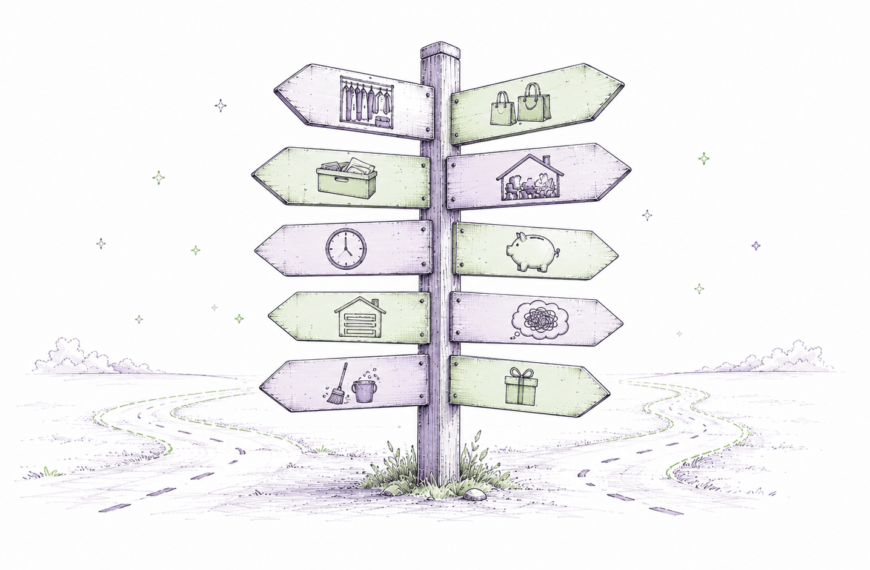
Sorted into seven honest categories. Less weight. More room. More life.
I had boxes of Lego. Wonderful stuff — decades’ worth, complicated builds, the kind of detail only a kid with too much time will commit to.
They sat in storage for twenty years or so.
Then I gave them to some kids who lit up when they saw them. That tells you something. Those Legos were quite a bit better off in their hands than in my crawlspace.
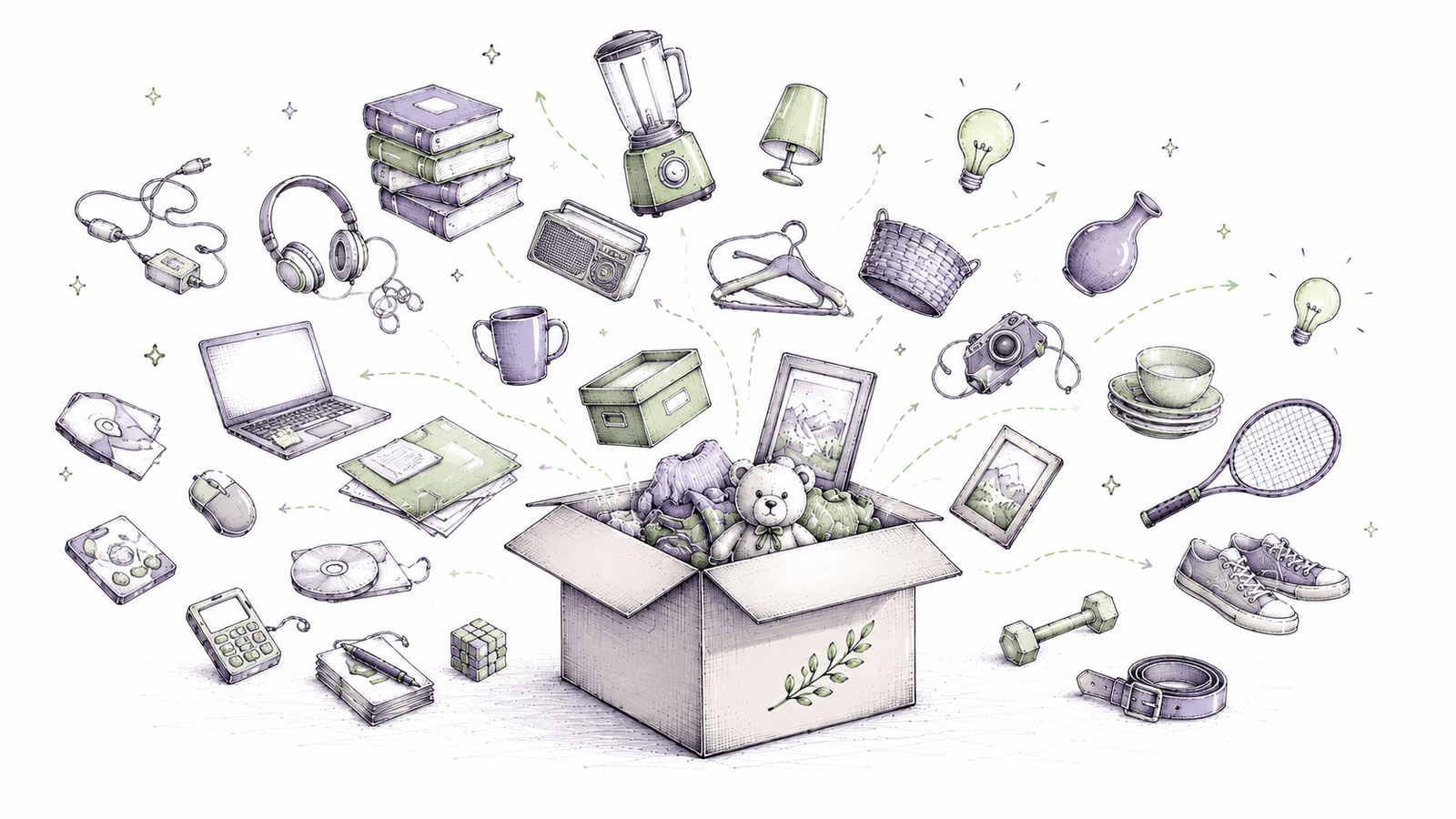
We live in a world where it has never been easier to accumulate things. A few clicks. A few deliveries. Before long, a home full of items we no longer use, no longer need, or rather, completely forgot we owned.
Letting go is not about becoming a minimalist. It is not about living with less for the sake of less. It is about making intentional decisions about what still deserves space in your life now.
How about a list to help you find the reason that speaks to you?
Below: fifty reasons, sorted into seven honest categories. Some practical. Some sentimental. Some plain. Take what speaks to you. Leave the rest. Pick one. Then pick a drawer.
1. It Has Changed (Or You Have)
The simplest category. Sometimes the object itself has shifted — broken, outdated, replaced. Sometimes you have shifted — different size, different taste, different life. Either way, the item is no longer working.
1. It’s broken. The cost to repair often exceeds the cost to replace. If you have been postponing the repair for a long time, that tells you something.
2. The technology is obsolete. Old monitors, cables for devices you no longer own, storage media you can barely access anymore. Technology ages much, much faster than the houses storing it.
3. You bought a better version. Newer skis. A sharper knife. A more efficient kitchen tool. A better office chair. In most cases, you are not going back. The old one is just taking up space.
4. It doesn’t fit anymore. Clothes that are too small, too big, too tight, too awkward. Shoes that hurt your feet. None of those are doing you any favors.
5. It’s out of style — for you. Not fashion in the abstract. Your actual style, today. Would you honestly wear it if the weather were right and you were going somewhere?
6. It’s uncomfortable. The itchy sweater. The chair that looks nice and feels awful. The shoes that pinch every single time. Discomfort is a perfectly good reason.
7. It’s incomplete. A game missing pieces. A furniture set with missing parts. A charger without the device. A lid without the container. Incomplete items quietly drain energy.
8. It is no longer safe. Worn-out ladders. Expired chemicals. Unstable furniture. Frayed cords. Moldy fabrics. Failing electronics. Safety beats sentiment.
2. You’re Not Using It
The honest test. Not might I use this someday? Have I used this lately? Items in active life earn their space. Items in storage limbo do not.
9. You no longer use it. It was once useful, perhaps even cherished. Now it sits. Time to pass it on. (See: my Lego boxes.)
10. You forgot you had it. Rediscovering something with surprise is a quiet signal. Essentials do not get forgotten.
11. You bought a duplicate because you couldn’t find the first one. The system has failed. Owning the same thing twice rarely solves the underlying problem.
12. It’s been untouched for a year or more. Not a perfect rule, but a rather useful one. If you haven’t used it in a year, ask honestly why it still earns space.
13. You’re keeping it “just in case.” Some “just in case” is wise. Most is speculative storage.
14. It has been demoted to deep storage. Basement, attic, crawlspace, back shelf. Items in deep storage usually stay there for years, untouched, until somebody else has to deal with them.
15. You’re storing it for someone else — indefinitely. Helping somebody for a few months is generous. Becoming long-term free storage is something else.
16. It is a duplicate. How many measuring cups, extension cords, water bottles, spatulas, screwdrivers, tote bags, and throw blankets does one household really need?
3. The Clutternomics™ Question
Every item costs you something — space, time, attention, money. Clutternomics™ is my framework for putting numbers on those costs, which makes the decisions much, much easier.
17. It’s rare-use plus big. A 30-foot ladder. A giant punch bowl. Oversized serving platters. Big items earn or lose their keep faster than small ones.
18. It could be sold and the money could serve you better. Collector’s items, duplicates, hobby gear, unused furniture. Cash in your pocket beats dust on a shelf.
19. It’s easy to borrow. Ladders, specialty tools, party gear, camping equipment, child car seats, extra chairs. Borrowing is much, much cheaper than housing.
20. It’s easy to re-acquire if you ever need it. Common, affordable, available — these items rarely earn long-term space.
21. It’s taking up prime real estate. Your home has high-value zones: counters, the closet near the front door, eye-level shelves. Low-value items in those spots displace far better uses.
22. It’s keeping your car out of the garage. A huge one. If the garage is full and the car sits outside in the snow, something has clearly gone off track.
23. You’re keeping it because it was expensive. That money is already gone. The question now is not what it once cost. The question is whether it still earns its place.
24. It could be digitized. Paper files, photos, manuals, instructions, old notes. Many things can live as bytes instead of bulk.
25. It’s not worth what it costs in space. A pure Clutternomics™ question: what is this item displacing, and is the trade worth it?
4. The Identity Question
Some items represent a version of you. The you who scrapbooked. The you who was going to learn guitar. The you whose parents kept that vase on the mantel. Honoring those past selves is fine. Carrying every one of them forever is something else.
26. It belongs to a different phase of your life. Old hobbies. Parenting eras. Sports gear from a body that has moved on. Not every chapter packs up nicely.
27. It belongs to your fantasy self. The guitar you were going to learn. The craft supplies for the business that never started. The machine for the project you abandoned. Hopes and guilt, in physical form.
28. The hobby is over. You used to sew, scuba dive, snowboard, build model airplanes. The inventory should not outlive the hobby by twenty years.
29. It belongs in a museum more than in your home. Old technologies, project items, certain collector pieces. Sometimes appreciation does not require possession.
30. You inherited it, but not its meaning. Not every inherited object is an heirloom. Sometimes it’s just an inherited object without a role in your life.
31. A photo of it would preserve enough of the memory. Not everything sentimental needs to remain physically present. A photo and a short note often do the work.
32. It no longer supports who you are now. The simplest version of this whole section. Your home should reflect who you are, not every version of yourself you have ever been.
5. The Cost in Friction
The hidden tax. Stuff costs more than the price tag. Daily friction adds up — minutes, energy, mental load.
33. It blocks a better use of the room. Your spare room could be a guest room, an office, a studio, a workout space. Instead, it holds boxes.
34. It makes cleaning harder. More stuff means more to move, dust, organize, and step around. The math works against you.
35. It creates visual stress. Even useful things become exhausting when too many of them compete for attention.
36. It slows you down. When finding what you need takes longer than it should, your stuff is quietly costing you time.
37. It requires maintenance you no longer want to provide. Some items cost more than money. They cost upkeep, parts, repairs, and mental bandwidth — quite a lot of it.
38. It makes your home less functional. Not every clutter problem is visual. Sometimes the bigger issue is that things have quietly stopped your rooms from working the way they should.
6. The Cost in Feelings
The other hidden tax. Some items quietly carry guilt, obligation, or shame. Walking past them every day is its own kind of weight.
39. It reminds you of obligation more than joy. If an item makes you feel bad whenever you see it, that is worth paying attention to.
40. You keep postponing the decision. Indecision is still a decision — to let the item keep taking up space.
41. It adds more guilt than value. The unread books. The untouched equipment. The unfinished kits. The abandoned projects. If an item mainly reminds you of what you are not doing, reconsider it.
42. You’re embarrassed for others to see it. That is not a signal to hide it better. It’s a signal to deal with it.
43. You avoid inviting people over because of it. A real quality-of-life issue. Worth solving.
7. The Next Chapter
The forward-looking category. Items get a final review against the chapter you are actually moving into. Some will not survive that review — and they shouldn’t.
44. Your children have moved out, and their things are still there. At some point, “temporary storage” needs to become a conversation.
45. It would serve someone else more than it serves you. One of the very best reasons. Pass it into active life.
46. It is keeping you from creating an office. If you work from home, write, or run a small business, unused stored items may be the only thing in the way.
47. It is keeping you from creating a guest room. A guest room should serve people, not storage overflow.
48. It would lighten the burden on others later. At some point, somebody else may have to sort through what you leave behind. Reducing that burden is a generous act — eye-to-eye, while you can.
49. You want a simpler next chapter. Whether you are moving, downsizing, aging in place, or simply resetting — too much stuff makes every transition harder.
50. You want your home to support your life again. The biggest reason of all. More calm. More function. More space. More clarity. Less searching. Less postponing. Less weight.
A Simple Shift in Perspective
Letting go is not about loss. It is about alignment.
Every item in your home takes up physical space, mental space, and — quite often — emotional space, as well. When those items no longer serve you, they quietly start working against you.
What we can do is start small. One drawer. One shelf. One category. One room that has been bothering you for years.
Ask a simple question:
Does this still deserve space in my life — right now?
If the answer is not clear, that’s usually your answer.
If You’d Like Help
If you are ready to simplify your home, reclaim space, or prepare for the next chapter, Smart Reduction™ is exactly the work I do with clients. As a coach, side by side, or by taking on more of the heavy lifting.
Interested in learning more? Schedule a free Smart Reduction™ discovery call.
A Secret SOZZ post — simple recipes for a better life.
#Secret-SOZZ #Smart-Reduction #50-Good-Reasons